Start with what needs a place
Before choosing a shape or finish, notice what usually lands in your entryway. Coats, bags, scarves, keys and a dog lead do not all need the same kind of hook. A broad, rounded hook can be kinder to a coat or bag strap than a narrow peg, while a small hook may be enough for keys. Count the items that need a regular home, then allow a little spare capacity for guests or changing seasons.
Think about how the hooks will be used during a busy departure. Items used every day should be easy to reach without moving a chair or shifting other belongings. If children use the entryway, a few lower hooks can make it easier for them to put away their own things. Keep hooks clear of the door swing and any route people need to walk through.
Choose a layout that fits the wall
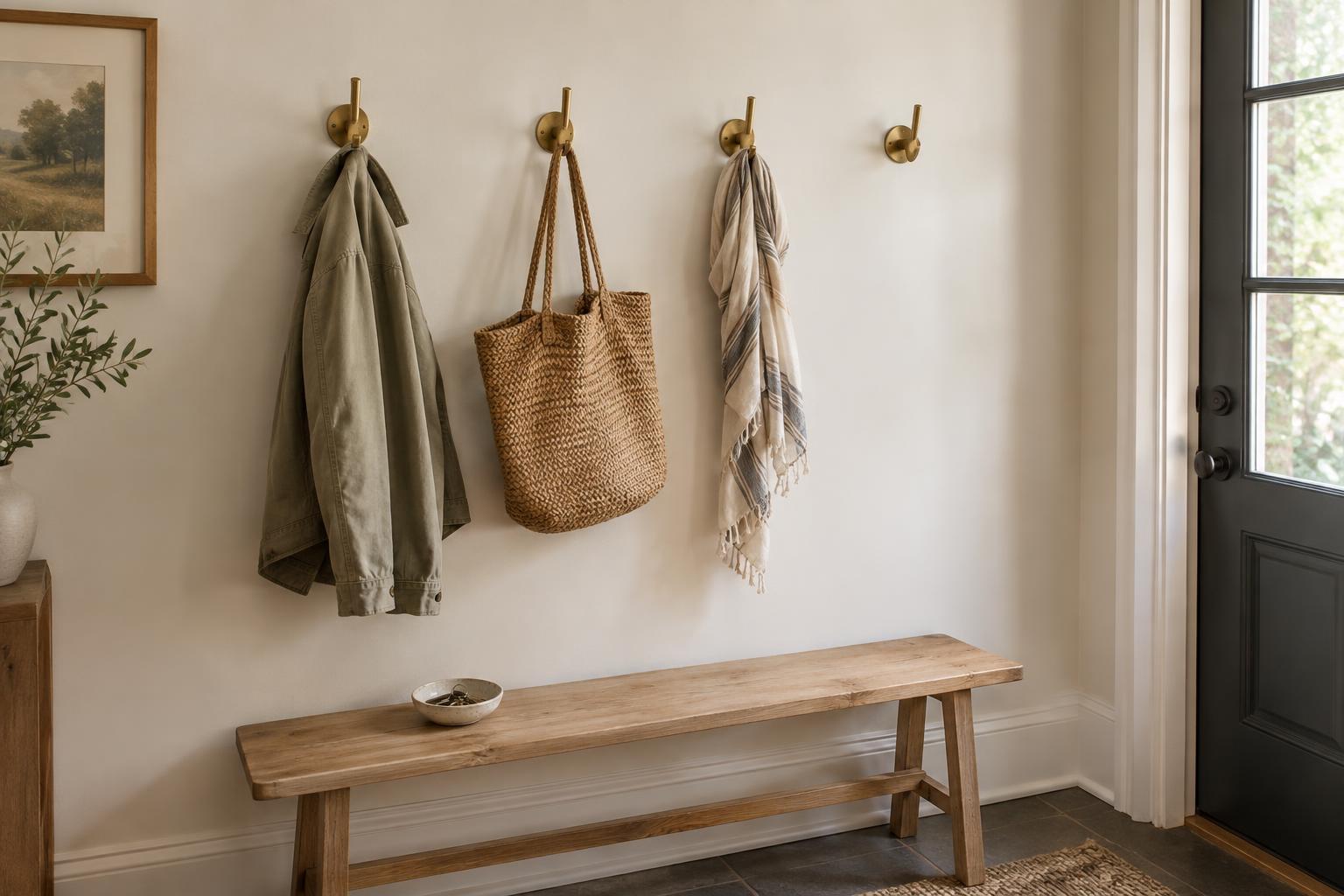
A single row gives a narrow entryway a calm, orderly look. Individual hooks offer more flexibility: you can space them around a mirror, above a bench or along a wall with an awkward corner. A hook rail can bring several hooks together visually and may make positioning simpler, but check its overall length against the available space before buying.
Leave enough distance between hooks for coats and bags to hang without becoming one crowded bundle. Hold paper cutouts or removable tape against the wall to test the arrangement, then hang the items you expect to store there. This simple trial can reveal whether a bag will block a light switch, whether a long coat will bunch up on a bench, or whether the hooks feel too high. In a small entryway, fewer well-placed hooks may be more useful than a tightly packed row.
Match the hook to the job and the wall
Appearance matters, but so do the hook's shape and construction. Look for a smooth surface without sharp edges that could catch fabric. Check that bags cannot slip off too easily and that the projection from the wall suits the space. Hooks that stick out farther may hold bulky items more comfortably, but they can get in the way in a tight passage.
Consider the wall before settling on a design. A lightweight hook intended for a small accessory is not necessarily suitable for a heavy everyday bag or several coats. Follow the maker's guidance on weight limits and fixings, and use hardware appropriate for the wall material. Plasterboard, masonry and timber can call for different approaches. If you cannot confirm what is behind the wall, or you are unsure how to fix the hook securely, seek help rather than guessing. Adhesive options may suit light items, but check their surface and weight requirements carefully.
Coordinate the finish with nearby details
Decorative hooks can make an entryway feel considered without requiring a full redesign. One approach is to repeat a finish already present in a door handle, mirror frame or light fitting. Another is to introduce a deliberate contrast: dark hooks can stand out against a pale wall, while timber can soften an entryway with many hard surfaces. The finishes do not have to match exactly; a shared tone or shape can be enough to make the pieces feel connected.
Think about maintenance as well as colour. Fingerprints may show more readily on some polished finishes, and textured details can take longer to clean. In a frequently used entryway, a simple silhouette and an easy-to-wipe surface often strike a good balance between decoration and practicality. If you choose several different hooks, give them a common feature, such as colour or material, so the arrangement feels intentional.
Give the hooks room to work
Hooks look their best when the surrounding area supports how you use them. A shallow shelf or tray can catch smaller items that would otherwise disappear under coats. A bench gives people somewhere to sit while changing shoes, provided hanging bags will not hit anyone seated below. A mirror nearby can make the entryway more useful without adding to the number of objects on the hooks.
Once the hooks are installed, try them for a week before adding more. If one position is always empty while another is overloaded, the issue may be placement rather than quantity. Keep rarely used outerwear elsewhere when possible, leaving the entryway for items that need to be close at hand. That small habit helps decorative hooks remain a useful feature instead of becoming an overflowing storage spot.