Start with the tabletop, not the old tablecloth
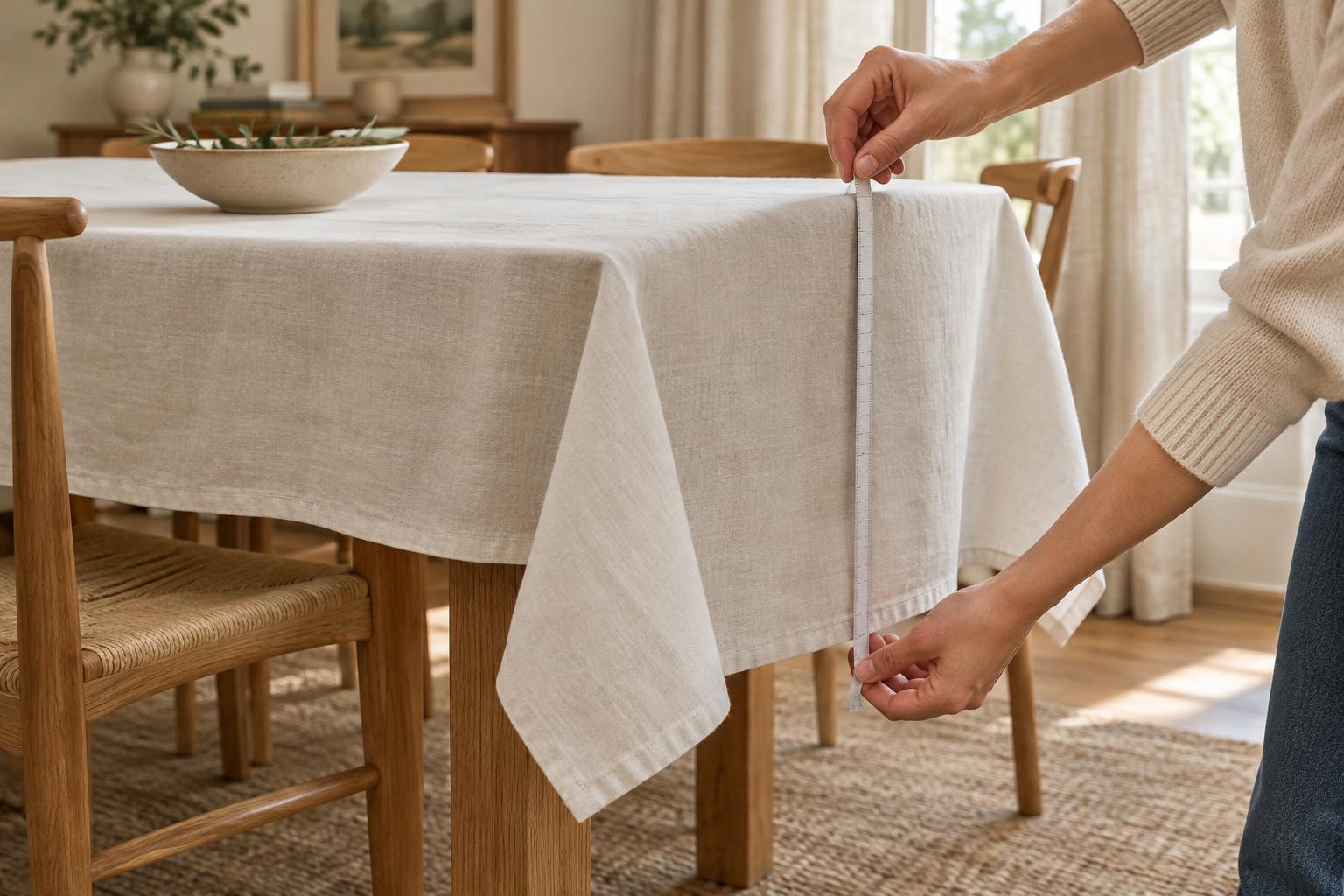
The “drop” is the amount of fabric that hangs over the edge of the table. To find a tablecloth size, you need two things: the dimensions of the tabletop and the drop you want on each side. Measure the table itself with a tape measure, keeping it level and measuring across the surface rather than down the edge.
For a rectangular or square table, record the length and width. For a round table, measure the diameter straight across the centre. For an oval table, record its greatest length and widest point. Use the same unit throughout your calculations. If your table has extension leaves, measure it both with and without them, then decide which arrangement the cloth needs to fit.
Choose a drop that suits the room and the meal
A short drop gives a casual look and is less likely to get in the way of seated guests. Around 15 to 20 cm can work well for everyday dining. A drop of roughly 20 to 30 cm creates a fuller appearance while usually leaving room for knees and chairs. These are starting points, not rules: the best length depends on your table height, chairs and preference.
Check the available space before choosing a longer drop. Measure from the tabletop down to the seat of a chair pushed in, and look for rails, drawers or a decorative apron beneath the table edge. If fabric hangs across a drawer you use regularly or catches on chair arms, a shorter drop may be more comfortable. A floor-length cloth calls for particular care: check the distance from tabletop to floor in several places, especially if the floor or table is uneven.
Calculate the size for your table shape
For a rectangular or square table, add twice your chosen drop to each tabletop measurement. For example, a table measuring 180 cm long by 90 cm wide needs a 220 cm by 130 cm cloth for a 20 cm drop on every side: 180 + 20 + 20 for the length, and 90 + 20 + 20 for the width. Centre the cloth to keep the drop even.
For a round table, add twice the drop to the diameter. A 120 cm diameter table with a desired 25 cm drop needs a round cloth about 170 cm in diameter. For an oval table, use the rectangular calculation as a starting point: add twice the drop to both its maximum length and width, then look for an oval cloth close to those dimensions. Because oval shapes vary, check the finished cloth’s shape as well as its stated size.
Check the finished size before you buy
Tablecloths are often sold in set sizes, so an exact match may not be available. If the cloth is slightly larger than your calculation, divide the extra length or width by two to see how much more it will hang on each side. If it is smaller, do the same to see how much shorter the drop will be. This makes it easier to compare nearby sizes than relying on a label such as “six-seater.”
Look for the finished dimensions in the product description and check the care instructions. Some fabrics may change size after washing, particularly if the maker has not accounted for shrinkage. If you are sewing a cloth yourself, allow extra fabric for hems and any expected shrinkage before cutting. Pattern placement matters too: a border or large motif may look uneven if the cloth has to be shifted to hide a size mismatch.
Do one final fit check
Before settling on a size, picture the table as you normally use it. Will a runner or placemats sit on top? Will the table often be extended? If both table lengths are used frequently, two cloth sizes may fit more neatly than one compromise. Alternatively, a runner can dress a table without covering its full surface.
When the cloth arrives, spread it out and measure the drop at the middle of each side. Adjust it until those lengths are as even as possible, then pull out a chair and sit down. The right tablecloth is not simply one that fits the measurements: it should stay comfortable during a meal and give the table the look you intended.