Start with what actually arrives at the door
An entryway catchall works best when it reflects your daily routine rather than an idealised picture of a tidy hallway. Notice what you tend to put down as you come in: keys, sunglasses, a transit card, earbuds or a small piece of mail. Give everyday items a designated spot, and keep things that belong elsewhere, such as receipts or loose change, from becoming permanent residents.
Before buying a tray or adding hooks, choose a landing place close to the point where you naturally pause. A catchall across the room may look good but be easy to ignore. If you share the entrance, allow enough space for each person’s essentials without requiring everyone to sort through one crowded bowl.
Choose a surface that suits the space
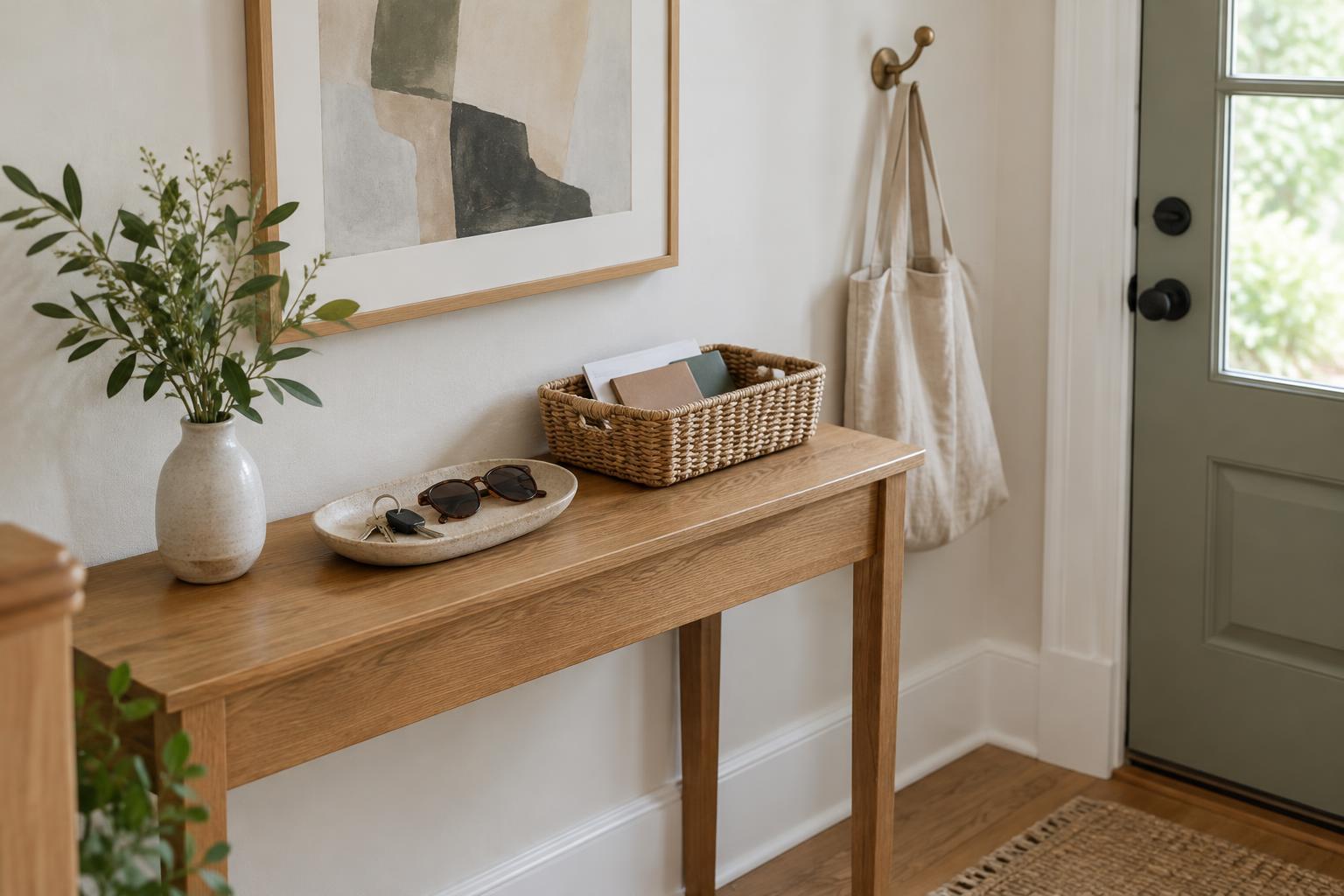
A narrow console, shelf or existing cabinet can hold a compact catchall. Leave room beside it for anything you need to set down briefly, such as a bag or a parcel. In a small entryway, a wall-mounted shelf with hooks underneath can provide a landing place without taking up floor space. Check that the shelf is easy to reach and does not obstruct the door or walkway.
Think about how the surface will handle daily use. A tray with a raised edge can contain small objects on a smooth tabletop, while a washable mat can protect a delicate finish. If you use a lidded box, reserve it for items you need less often; keys are easier to put away consistently when their spot requires only one simple movement.
Give each essential an easy-to-recognise home
One large bowl can quickly turn into a jumble. Instead, divide the catchall by purpose. A shallow dish can hold keys, a small compartment can take cards, and a separate spot can keep sunglasses from being scratched by metal objects. Hooks can be useful for lanyards or key rings, provided there is enough space to lift each one off without disturbing the rest.
Choose containers that are roomy enough for normal use but not so large that they invite unrelated clutter. If several people use the area, separate dishes or clearly spaced hooks may be more practical than labels. Keep the arrangement simple enough to understand at a glance, especially when someone is leaving in a hurry.
Make it feel like part of the room
A catchall can be functional without looking purely utilitarian. Repeat a material or colour already present nearby: a wooden tray might relate to a mirror frame, while a ceramic dish could echo a lamp or vase. Mixing textures can also work well, such as a smooth dish on a woven mat, as long as the surface remains easy to wipe and the objects sit securely.
Treat decoration as a supporting detail rather than the main event. A small framed picture or a single sturdy vase can make the area feel welcoming, but leave a clear path to the items you reach for daily. If the entryway is dim, ensure that the catchall is visible with the lighting you normally use. The aim is a calm, legible arrangement, not a display you must move aside to find your keys.
Keep the system useful over time
Even a well-planned catchall needs a quick reset. When you pass it, return stray items to their places and move mail, packaging or objects from other rooms along to their proper destinations. If one category repeatedly overflows, consider whether it needs a larger container, a different location or a more regular clear-out.
Seasonal changes can be small. You might make space for gloves in colder months or sunglasses when you use them more often, while putting the less-needed item away. Reassess the setup whenever your routine changes. A successful catchall is not one that stays perfectly styled; it is one that makes arriving home and heading out a little easier.