Start with the space you need to keep clear
Before choosing what goes on the tray, think about how you use the coffee table. Do you set down a drink while reading, share snacks there, or need space for a laptop? Leave a clear area for those habits first. A tray should organise the remaining space, not make you move decorations every time you sit down.
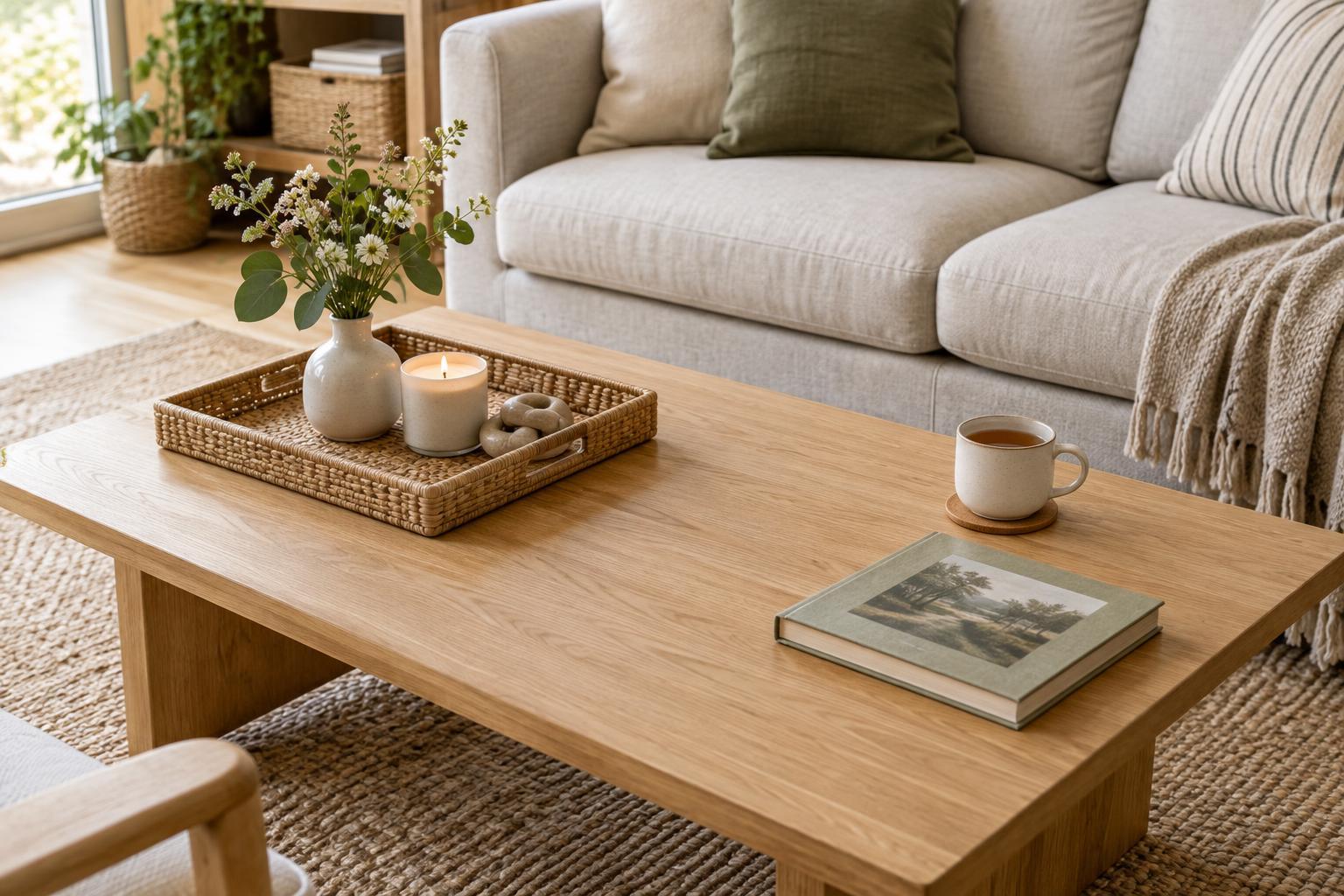
A useful starting point is to keep the tray on one side of the table rather than centring it automatically. This leaves a predictable landing spot beside it. On a small table, one modest tray may be enough decoration on its own. On a larger table, you can allow more space around the tray without filling every gap. Check the arrangement from the sofa: you should be able to reach the clear area comfortably and see the people sitting opposite you.
Choose a tray that suits the table
The tray should be large enough to hold its contents without objects crowding the rim, but small enough that the table still works without it being moved. Before buying one, try placing a sheet of paper or a book where you imagine the tray will sit. This gives you a simple way to judge how much usable surface remains.
Shape and material affect both appearance and upkeep. A round tray can soften a rectangular table; a rectangular tray can align neatly with its edges. A raised rim helps keep small objects together, but make sure it does not make frequently used items awkward to pick up. Choose a surface you are willing to wipe down, especially if the tray will hold drinks. If it has a rough underside or heavy feet, add discreet protection or check that it will not mark the tabletop.
Build a small arrangement with a clear purpose
Start with two or three types of item rather than a collection of everything you would like to display. A low stack of books, a small bowl and one decorative object can offer different shapes without making the tray feel crowded. The bowl might hold a remote or other small essentials; it does not have to be purely decorative. Leaving some of the tray visible gives the arrangement room to breathe and makes objects easier to lift.
Vary heights gently. A short vase can add interest beside flatter pieces, but a tall or broad arrangement may block conversation or make reaching across the table difficult. If you use flowers or greenery, check for loose leaves and water that could reach books or the table. Keep fragile pieces away from the tray’s edge, particularly where people regularly set down cups. The goal is a grouping that looks intentional from the sofa and feels straightforward to use.
Make the tray easy to move and reset
A tray is most useful when you can lift it aside to make room for a meal, game or project. Test the finished arrangement by moving the tray with both hands. If objects wobble, remove one or choose shorter, steadier pieces. A heavy stack of books or an unstable vase can turn a convenient tray into something nobody wants to move.
Give everyday items a consistent place so the arrangement is easy to restore. If the remote lives in the bowl and coasters sit beside it, tidying takes only a moment. Keep coasters accessible rather than buried beneath decorative pieces. When the tray is off the table, set it somewhere stable; this is another reason to avoid overfilling it.
Refresh the look without rebuilding it
Once the layout works, you can change its mood by swapping one small element. Try a different bowl, a book with a contrasting cover, or a low seasonal object. Repeating a colour or material already present in the room, such as a cushion tone or a wood finish, helps the tray feel connected to its surroundings.
Resist the urge to add something every time you find a new piece you like. Remove an item before adding another, then check whether the table still has an open landing spot. A successful coffee table tray is not a fixed display: it is a compact arrangement that makes the table pleasant to look at while leaving it ready for daily life.