Start with the job the mirror needs to do
A decorative mirror can serve as a focal point, fill an empty stretch of wall or reflect a pleasing part of the room. Decide which job matters most before choosing a shape or frame. A mirror intended to add detail above a console need not be large enough for a full-length view; a mirror you plan to use while getting dressed does.
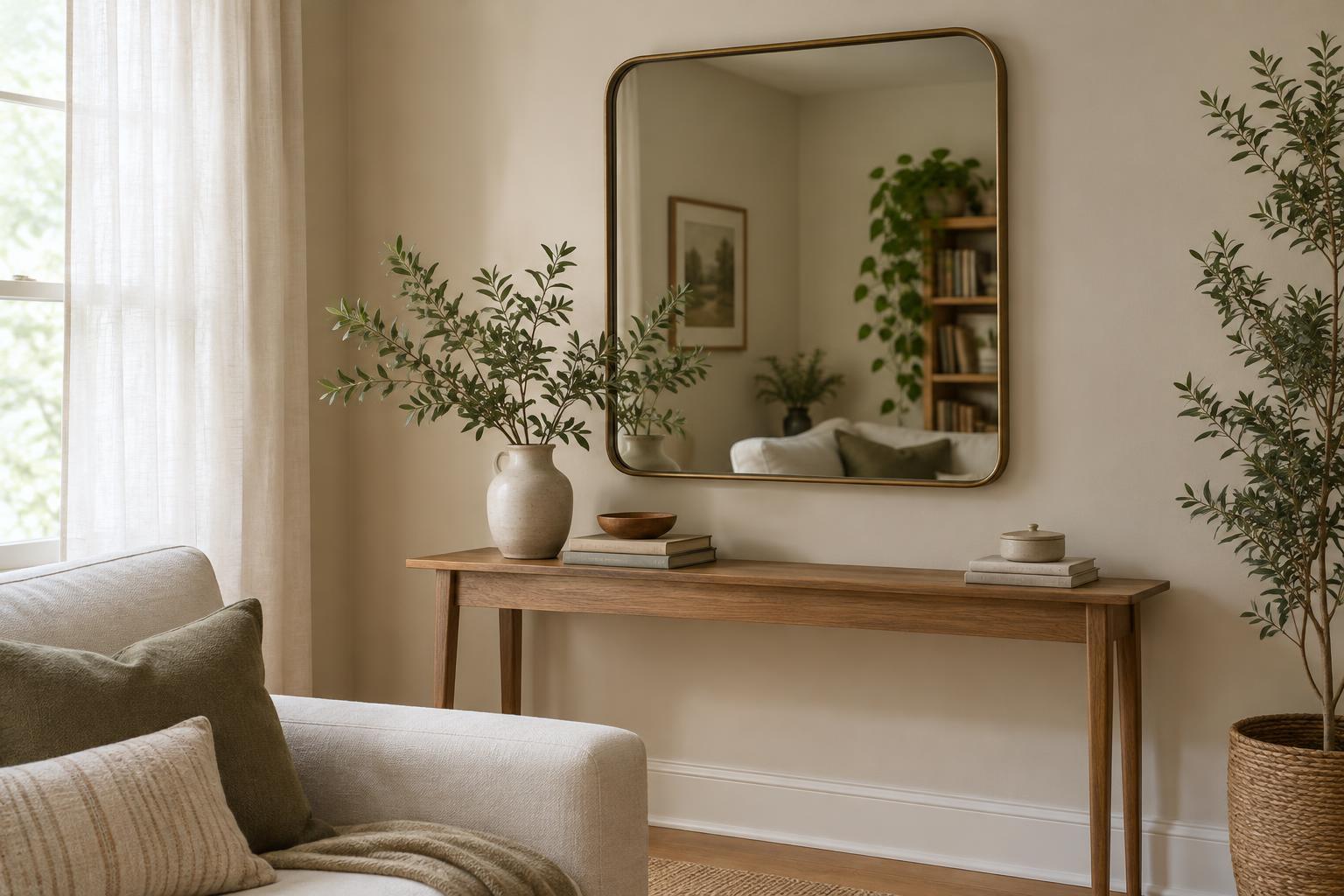
Look at the wall and the furniture beneath it as one arrangement. Above a console, chest or mantel, a mirror usually looks more connected to the furniture when it is narrower than the piece below. Leave some visible wall around its edges so the arrangement does not feel crowded. In a narrow space, a tall mirror can draw the eye upward, while a wider one can help balance a long piece of furniture. These are starting points, not fixed rules: a paper template taped to the wall is an easy way to judge proportions before buying or drilling.
Choose a shape and frame that suit the room
A simple rectangular mirror can bring order to a wall with several small objects. A round or softly curved mirror can offset straight-lined furniture, while an irregular shape works best where it has enough space to be noticed. Consider the outline from across the room, not only in a close-up product image.
The frame affects how much visual weight the mirror carries. A slim frame tends to blend into a busy arrangement; a broad wood or metal frame can act more like a piece of wall art. To help it belong, repeat one element already in the room, such as a wood tone, a metal finish or a curved line. The match does not need to be exact. If the room has many finishes, a restrained frame may be easier to coordinate than another strong accent.
Check what the mirror will reflect
A mirror brings another view into the room. Before settling on a position, stand or sit where you normally use the space and imagine the view from that angle. A reflection of a plant, artwork or clear stretch of wall may feel calm; a reflection of storage clutter or a television may draw more attention than you want. Check the view from more than one seat, particularly if the mirror faces a sofa or dining table.
To test a possible position, hold a small mirror against the wall or ask someone to hold it while you step back. It will not show the full view of a larger mirror, but it can reveal whether the location faces an awkward corner or a bright light. A cardboard cutout can help you assess size, while the small mirror helps you assess reflection. Use both before committing to a large piece.
Avoid bright spots from windows and lamps
Glare is most distracting when a mirror sends a bright reflection into a place where you often look. Facing a window can bring welcome daylight into a room, but it can also reflect direct sun toward a chair, desk or screen. Look at the proposed spot at the times you normally use the room. Daylight changes direction, so a position that looks comfortable in the morning may feel different later.
Lamps need the same check. A bare bulb or bright shade reflected at eye level can become a persistent bright spot. Try moving the mirror to an adjacent wall, shifting it sideways or changing its height so the lamp is not visible from your usual seat. If the mirror must stay in that position, a shaded lamp or a different lamp location may make the reflection more comfortable. A slight tilt can change what the mirror catches, but only use it if the mirror and its fittings are designed to be mounted that way.
Test the height, then hang it securely
Before hanging, mark the proposed outline with removable tape and view it while standing and sitting. Think about both the top edge and the reflected view: hanging a mirror higher does not always improve it if it then catches a ceiling light. If it sits above furniture, leave enough separation for the two pieces to read clearly without making the mirror look disconnected. Check that doors, drawers and nearby objects have room to move.
Finally, account for the mirror’s weight and the wall it will hang on. Use fittings suited to both, follow the maker’s mounting guidance and make sure the mirror cannot be easily knocked out of place. A thoughtful position should work in everyday use, not just from one attractive angle. Taking time to test the scale, view and light makes it easier to choose a mirror that adds interest without adding a daily distraction.