Start with what the room already has
Before choosing a new lamp or cabinet handle, take stock of the metal that is already in the room. Door handles, taps, curtain poles, light fittings and furniture legs may all be visible at once. Some are easy to change; others are better treated as part of the room’s starting point. Note which finish appears most often, which pieces draw the eye, and which details are barely noticeable.
Choose one finish to act as an anchor. It might be the brass of a large ceiling light or the chrome of bathroom fittings. The anchor does not have to appear on every object, but giving it a few points of repetition helps the room feel connected. If a fixed feature is prominent, working with it is usually simpler than trying to conceal it with an entirely different selection of accessories.
Choose a small, deliberate palette
Two metal finishes are often enough to add variety. A third can work in a room with plenty of objects or architectural detail, but it takes more attention to distribute well. Begin with the anchor, then select a supporting finish for a different role. For example, brushed nickel could appear on practical fixtures while aged brass adds warmth through a lamp and picture frames.
Pay attention to the character of each finish, not just its colour. Polished chrome reflects more light than brushed stainless steel; antique brass looks softer than bright polished brass. Metals with similar levels of shine tend to sit quietly together, while a strong contrast in sheen becomes a more noticeable design choice. Neither approach is wrong. Decide whether you want the metals to blend into the background or become part of the room’s visual interest.
Black metal can be useful when you want a crisp outline, particularly against pale walls or timber. Treat it as a visible finish rather than an automatic neutral: a single black handle may look accidental, while black repeated on a lamp, table frame or curtain pole feels considered.
Repeat finishes without matching everything
A mixed-metal room does not need equal amounts of each finish. An approximate hierarchy is more helpful: one finish leads, another supports, and any third appears sparingly. If the main finish is on a large fixture, the supporting metal may need only two or three smaller appearances to feel present. Repetition matters more than perfect symmetry.
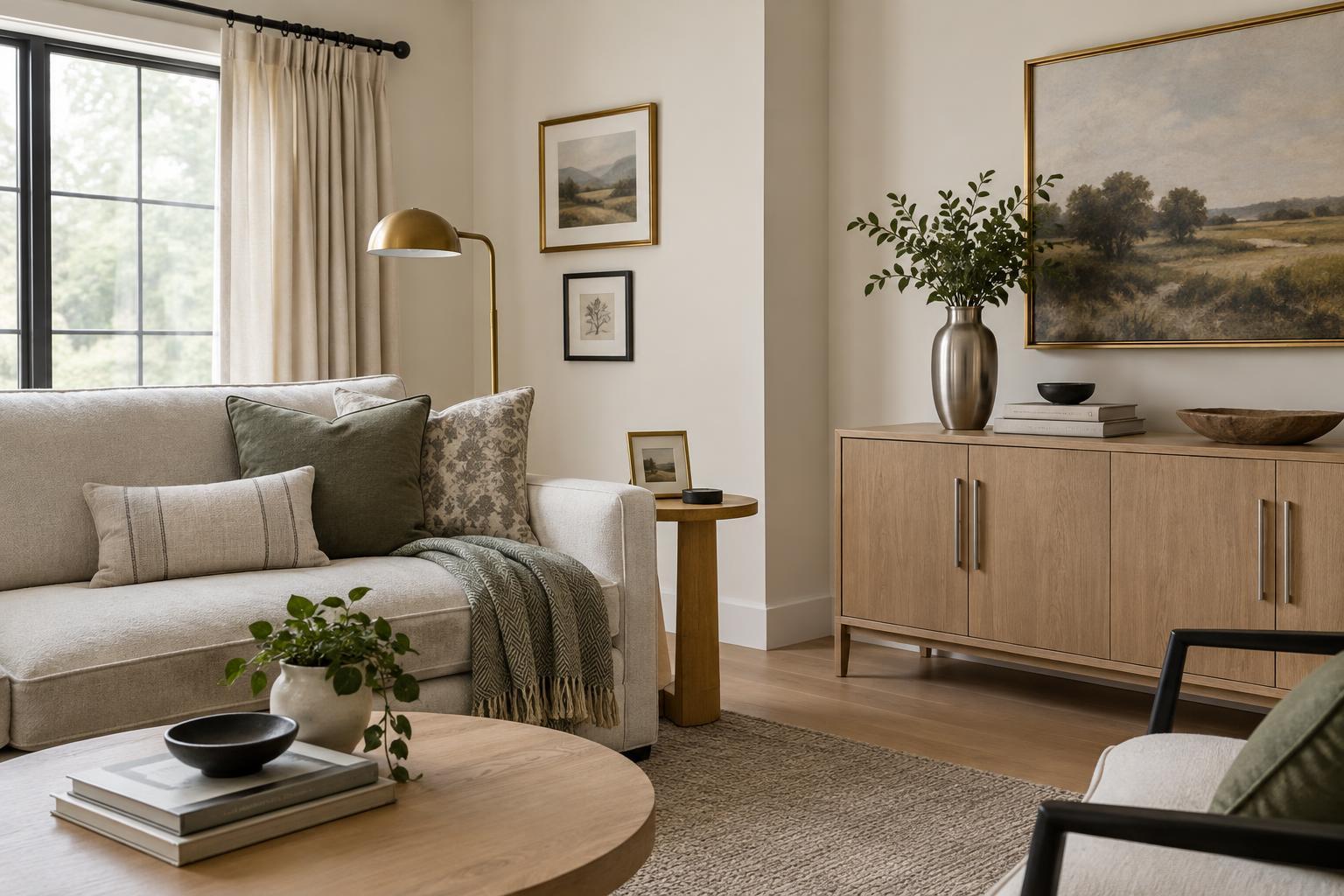
Spread those appearances around the room. A brass light at ceiling height, a brass frame on a wall and a small brass tray on a table create a visual path. If every brass item sits on one shelf while all the chrome is across the room, the combination may look divided rather than integrated. You can also bridge two finishes in a single object, such as a lamp with a dark stem and a warm metal detail, but this is an option rather than a requirement.
Let the surrounding materials do some of the work
Metal never appears in isolation. Wood, stone, paint and textiles influence how a finish reads. Warm brass can pick up the tones of oak or a rust-coloured cushion; chrome may echo cool stone or blue-grey paint. These connections need not be exact. The aim is to give each metal a reason to belong among the room’s other materials.
Contrast can be effective, too. A cool metal brings definition to a room full of warm timber, while a warm metal can soften a space with grey surfaces. If the combination feels too busy, look at the background before replacing the metal pieces. Reducing competing patterns, choosing a simpler lampshade or allowing more clear space around decorative objects may give the finishes room to breathe.
Test the mix at room scale
Before replacing a set of handles or ordering several fittings, try the proposed finish in one or two movable pieces. Place a lamp, frame or tray where the new metal would appear, then view the room from its usual entrances and seats. Check it in daylight and with the room’s lamps switched on: reflections and surface sheen can change noticeably with the lighting.
Finally, judge the whole room rather than comparing two finishes side by side. Your eye should move comfortably between them without one small detail demanding all the attention. If something looks out of place, try repeating that finish elsewhere, moving the item or choosing a quieter sheen. A successful mix is not a strict formula. It is a limited set of finishes used often enough, and thoughtfully enough, to feel at home together.