Start with what the room needs
The right curtain is not necessarily the thickest or the most decorative one. Begin with the window’s everyday jobs: admitting daylight, softening glare, providing privacy and making the room comfortable after dark. A living room where you want a bright, open feel may call for a different fabric from a bedroom where early light disturbs sleep. Consider what happens at the window both when the curtains are open and when they are closed.
Look at the room from outside if you can, particularly after switching on the lights. A fabric that feels private in daylight may reveal shapes or movement at night. Notice, too, whether direct sun falls on a screen, seating area or bed. These observations will help you choose based on how you use the space rather than on a fabric label alone.
Choose sheers when softness matters most
Sheer curtains are lightweight and translucent. They soften the view through a window, diffuse some daylight and add a gentle layer of texture without making a room feel closed in. They work well where you want daytime light and do not need complete privacy, such as a living area facing a garden. Their airy appearance can also balance heavier furniture or patterned furnishings.
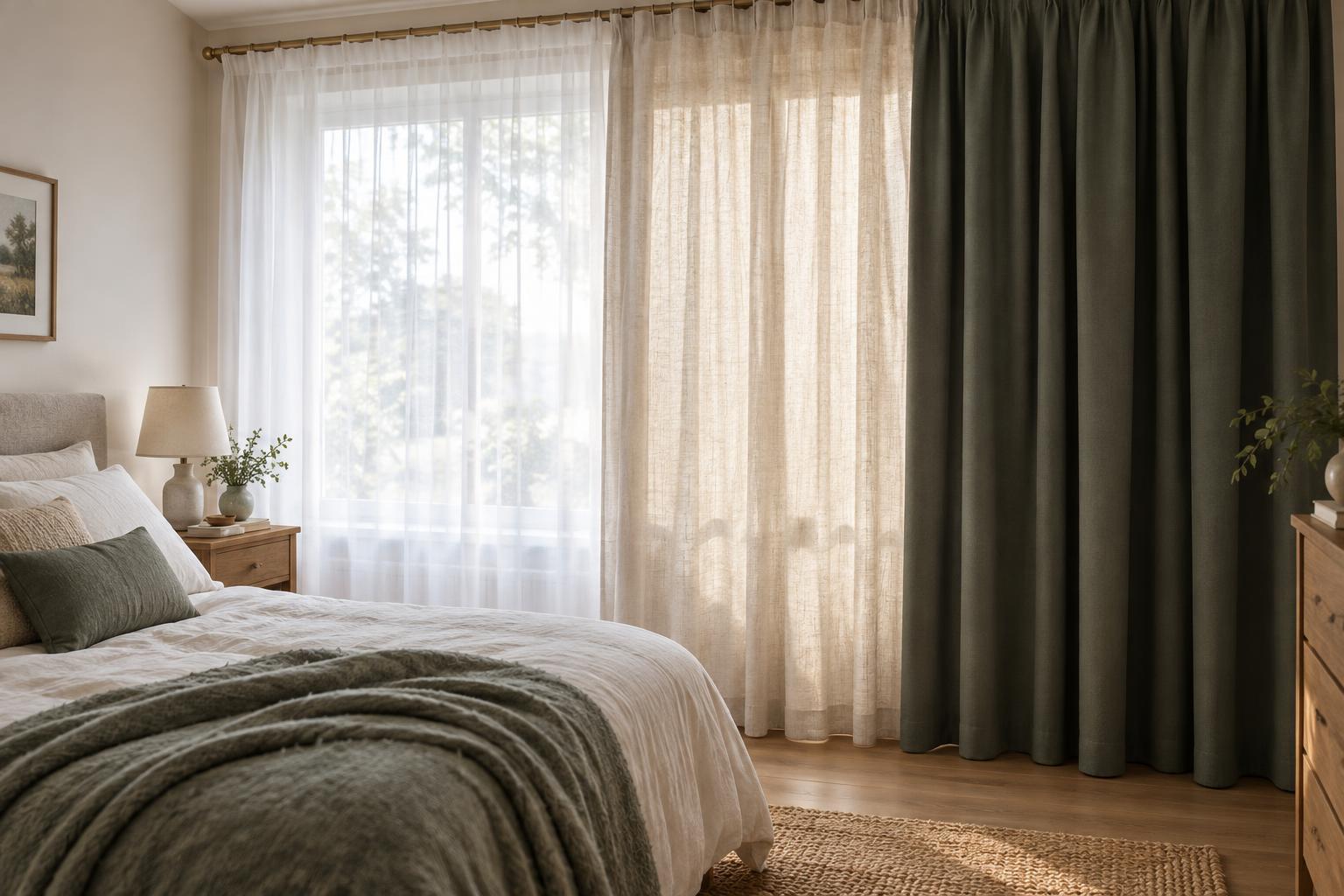
Sheers provide limited privacy, especially after dark when the interior is brighter than outdoors. They are not intended to block strong sun or darken a room for sleep. If you like their appearance but need more control, hang them with a second curtain or a blind. You can then keep the sheers drawn for a softer daytime look and close the other layer when privacy becomes the priority.
Use light-filtering curtains for an adaptable middle ground
Light-filtering curtains admit some daylight while reducing its intensity. Depending on the weave, colour and lining, they can soften glare more noticeably than sheers and offer greater visual separation from outside. They are a useful starting point for living rooms, dining areas and bedrooms where you welcome daylight but want the window to feel less exposed.
The term describes a broad range of fabrics, not one fixed level of coverage. A loosely woven pale panel may remain quite translucent; a denser fabric may give much more privacy. Hold a sample up to the light and, if possible, check its appearance with a lamp behind it. Think about colour as well: a bright white can feel crisp and airy, while a warmer neutral often creates a softer effect. Neither colour alone tells you how much light the fabric will block.
Pick blackout curtains when darkness is the priority
Blackout curtains are designed to block substantially more light through the fabric than sheer or ordinary light-filtering curtains. They are worth considering for bedrooms, nurseries or rooms used for daytime rest. The light-blocking layer may be integrated into the fabric or supplied as a lining, so you need not choose a particular visible colour or texture to get a darker room.
Even blackout fabric does not guarantee a completely dark room. Light can enter around the top, sides and bottom of the curtains, particularly if the panels barely cover the window. For better coverage, choose panels that extend beyond the window frame and hang them high enough to reduce the gap above. A wider rod or track gives the fabric space to cover the sides. Heavier curtains may also make a window feel less exposed to draughts, but the effect depends on the window and how the curtains fit.
Make the final choice practical as well as attractive
If you want different conditions at different times, layering is often more useful than asking one fabric to do everything. Pair sheers with blackout curtains for a bright daytime bedroom and a darker sleeping space, or combine a light-filtering curtain with a blind for occasional extra privacy. Check that the rod or track can carry the layers and that the panels have enough room to move without bunching awkwardly.
Before buying, measure the width of the area you want covered, not just the glass, and decide where the hem should fall. Panels need enough combined width to close comfortably while retaining some fullness. Finally, consider care instructions and how often the curtains will need cleaning. A fabric that suits your light and privacy needs but is difficult for you to maintain may not be the best everyday choice. The simplest test is to picture the room on a bright morning, a dull afternoon and an evening with the lights on: the right treatment should work across all three.